Origin Story and Trajectory
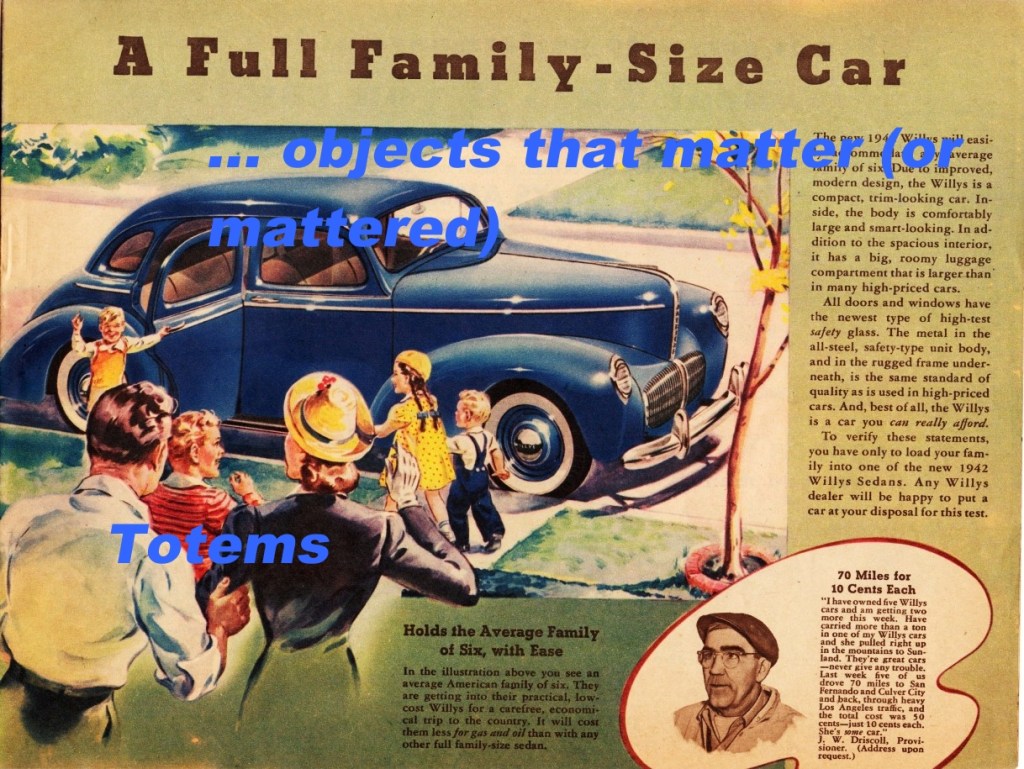
It wasn’t about mobility at first. There were already personal, horse-drawn conveyances and “trucks.” There was plenty of public transportation: streetcars, trains, boats, etc. And there was already well-developed capitalism (some say the Dutch invented it in the 17th century). There was autonomous mechanical mobility from steam engines and even electricity. But something clicked with a new class of mechanical tinkerers, today we’d call them engineers, scattered throughout various North American and European industrial environments, at about the same time in the last third of the 19th century. It was the invention of the internal combustion engine, which was quickly adapted to both wheeled vehicles and stationary machinery. These small groups of mechanics, experimenting in their workshops, eventually translated their inventions into corporate entities, backed by capital, and perceived by the owners of that capital in multiple countries as worth substantial risk! Something was happening here, worldwide, not unlike what we’ve seen over the last 30 or 40 years with digital technology. It ushered in a new world, which has lasted at least 140 years.
What can we distill from this 140-year adventure? What were its common features? What comes next?
In the Beginning
We all tend to think of the automobile industry as an American institution – largely due to our somewhat mythic image of Henry Ford. But it didn’t begin here. Ford may have invented mass production via assembly line, but he did not invent either the automobile or the market for personal “autonomous” transportation. Those things sprang up simultaneously in the U.S., Britain, France, and Germany. The American mass market may have worked to Ford’s advantage – it was the world’s largest — but the British, at least, were trying the same thing at about the same time. Germany had Daimler and Benz, and others came later. France’s market was less robust until after World War I, but soon developed to be exploited by Citroen, Peugeot and Renault. Italy had no mass market until after World War II, so its early years were limited to luxury, limited volume, makes (Fiat, Lancia, and Alfa Romeo). Much credit for “demand generation” has traditionally gone to General Motors’ Alfred P. Sloan and his strategy of market segmentation, but Austin and Morris in the UK were engaged in similar marketing experiments during the 1920s. And neither country’s industry provides conclusive evidence that its success was due more to demand generation than simply demand capture. In those days, the world of entrepreneurship may have benefited from some international communications, but not so much that we can credit either Sloan or Britain’s Lord Nuffield as primarily responsible for influencing the other. Neither French nor German manufacturers jumped on the market segmentation bandwagon to the same extent as those two nascent anglophone auto industries, which soon became dominant.
Explosive Growth
Whatever the economic, cultural, and technological causes, the growth of the world automobile market was uniformly stupendous between the wars. By the 1930s, despite a global financial crisis, auto markets continued to grow with populations in both North America and Europe. Even Japan launched a coterie of fledgling manufacturers, stimulated by massive investment from American and British automakers. Toyota, Nissan, and Isuzu all had pre-war origins. There was a common formula of incipient demand for personal transportation combined with growing industrial capacity that served to open new markets. Large highway programs connecting population centers still lay in the future, but the urban populations of the United States, Europe, and even Japan, managed to spike the demand for cars. Necessary infrastructure followed quickly; gas stations and repair/parts networks, dealer franchises, and traffic regulation in cities, including stoplights and standardized signage, accommodated the growth. All the world’s industrial societies apparently had enough social class differentiation that a proliferation of brands could be marketed at different price points – the bigger the market, the more effective that market segmentation was. An urban middle class was prominent in North America, Britain, France, and Germany by the start of World War II. They all bought, or desired, cars.
Desire: for a Better Future
Buying that first car became an important rite of passage – either from youth to adulthood, as in the United States of the 1950s, or from working class proletariat to petit-bourgeois middle class, as in Europe in those post-war years. Progress over generations, or class structures, could easily be manifested by trade-ins for another car (also, cars generally didn’t have reliability expectations much beyond two or three years until at least the 1960s). This was prosperity. Technology didn’t advance in this period nearly as fast as inflation. By the 1970s and 1980s, both limitations were putting dampers on automotive demand. But emerging manufacturing centers in Japan and (to some extent) Germany found a way to capitalize on the market malaise. Both Japan and Germany became automobile export powerhouses. This trend had built-in accelerators, so that by the early 21st century, Toyota and Volkswagen had become the largest and second largest world manufacturers, respectively – not because of huge domestic demand surges, but because of exports! They, not the legacy U.S. manufacturers, and certainly not the dying British motor industry, seemed to satisfy those familiar social and psychological motivators for many of the world’s auto markets. It’s not that the lessons of Alfred P. Sloan were totally ignored – the basis of market segmentation still seemed valid for the globalized auto industry, given reliability and aesthetic appeal. And it still relied on debt and credit, the cornerstones of all capitalist growth – everywhere.
Passing the Torch
It’s not hard to imagine developing markets for automobiles in other societies as economic and industrial conditions allow. Today, the two largest domestic auto markets are China and India. They have the population, they have the capital, they have the personal income growth necessary to greatly expand their respective automobile markets. And, like Japan and Germany in the second half of the 20th century, and the U.S. and Britain in the first half, they have become the world’s largest exporters of cars (along with Korea). It’s noteworthy that their export markets, unlike those earlier cases, are heavily dependent on countries in Asia, Africa, and Latin America — the emerging world. These are the places where the gross size of the market is rising at near the rates that the “Global North” saw in the last century. Call it progress? Can the legacy manufacturers in the U.S. and Europe compete with these new powerhouses? Our domestic markets can’t keep up for sure — demographics just don’t work that way. Perhaps it’s time for us to transition away from that behemoth personal transportation industry?
Lessons Learned
It may be that the aspirations that drove the great 20th century industrial mindset were fraudulent aspirations. If we had collectively understood the limitations of the planet better (fossil fuels) – and there hadn’t been such overweening pressure to produce more – we might be in a better position now as a civilization. But we are where we are, and we largely enjoyed the journey to get here. Even with ghastly world wars and an unspeakable legacy of slavery and colonialism, enough of us felt, through the 20th century, that we were headed in the right direction – upward! This orientation even included survivors of the defeated powers in both world wars; their shared trajectory was always upward. Is that “Steampunk” era now over? I can see the next 140 years as a forced reconciliation: cooperation over competition, sharing resources over exploitation of labor, the environment, and consumers. Such values cannot be addressed by the marketplace alone. Henry Ford did build something, but I’m afraid Alfred P. Sloan only manipulated it.
— William Sundwick
 Warp and Woof