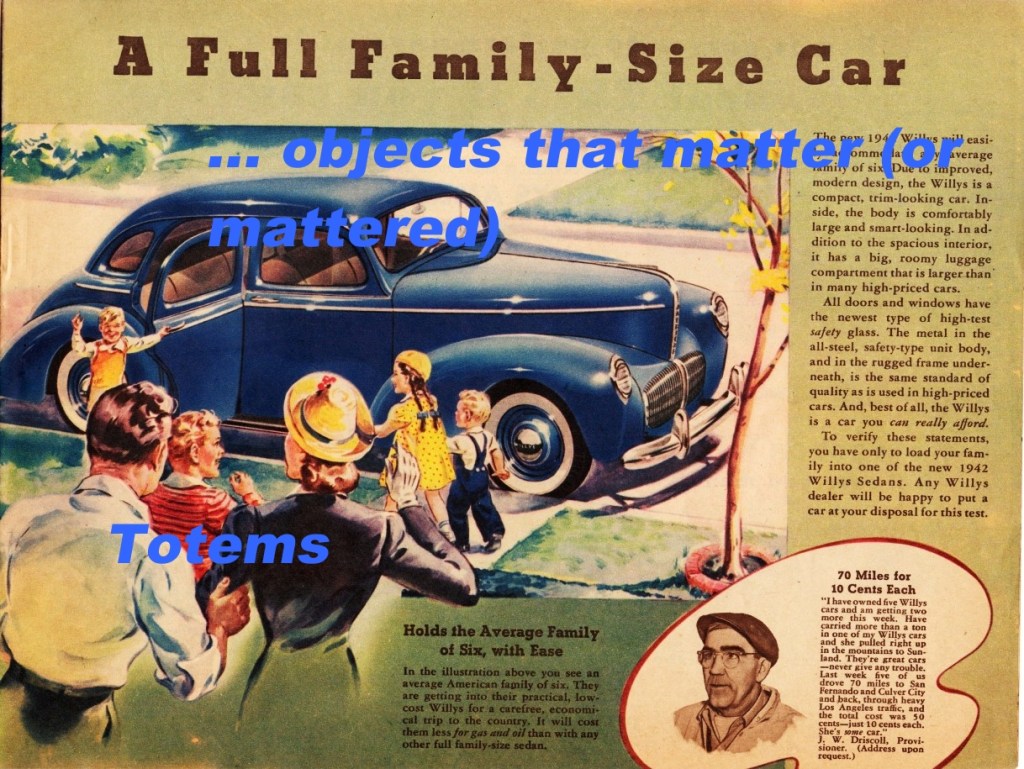
In the 1950s, when I was a kid in Flint, Michigan, the future looked bright. There was no reason to think then that the city, one of the founding centers of the industry that had come to dominate the American economy, would last only about two more generations before sinking into what now seems like an irretrievable fate of rust-belt despair and entropy. But that’s what became of most of the U.S. automobile industry – and many say, by extension, to the entire industrial infrastructure of the nation.
What happened? And what are the alternatives to a car-based civilization, anyway? As a perceptive and thinking youngster, I did begin, gradually, in my teens to gain a sense of foreboding about all this. It seemed altogether too much faith was placed in things which no intelligent person could possibly consider important. In Flint, that meant according status to what kind of car your parents drove, down to the details of trim, options, and colors. And after gaining that magical right of passage, a driver’s license, you became obsessed with obtaining a truly “boss” ride. (For me, nothing surpassed the macho image of the Chevy Impala 409 of the early ‘60s!) I was fortunate enough, however, to have a circle of friends who were somewhat skeptical of this preoccupation. It all seemed too closely coupled with the systemic evils of capitalism. Flint, with its very working-class pride in the totems it created, was in those days a decidedly left-leaning political environment – at least among its more discerning youth. The UAW was both the predominant political player in the community and a commanding intellectual force – via the new Flint branch campus of the University of Michigan.
Perhaps the motorized nation was a natural outgrowth of capitalism, and ultimately it was Wall Street that both giveth and taketh away. But what is next for America? Not just what Flint might have become (probably not much, in any likely scenario), but we understand now that the suburban, interstate-highway-connected, America of the last century was unsustainable, whether fossil fuel-based or not. There is too much wrong with that model. It was conceived in the postwar folly of urban sprawl. Somehow, urban centers, with pre-existing mass transit and commercial infrastructure in relatively compact geographies, were seen as too restrictive for growth. Racism may have been part of the cause, that phenomenon known as “white flight,” but I think the larger factor was the geography of existing urban conglomerations themselves. The automobile, now accessible to everyone, along with that other growth sector – highways — created the perfect storm for the suburbanization of America. Commercial activity followed housing development, so we got strip malls with huge parking lots – not walkable from your single-family house, but merely a short drive! At first, this inexorable march to the suburbs temporarily improved the fortunes of the auto-towns (Flint’s population didn’t peak until the 1970s).
But something else bad was happening to the American big three automakers (GM in Flint) – the global auto industry was encroaching on their safe market share here in the USA! The rise of the Japanese manufacturers was observed as early as the 1960s, but not sufficiently answered. The domestic market was changing, even as the suburban development project continued to gain momentum. From the ‘50s, European imports and American Motors (Rambler) had frightened GM, Ford, and Chrysler into downsizing their products. MGs, Renaults, and, of course, the ubiquitous VW Beetle captured large numbers of devotees in the U.S. (Many makes from many different countries came to our shores; we even had a neighbor who bought a Czech Skoda in this period.)
The imports were smaller and more economical than big American cars – and, from the 1980s, American car buyers tended to consider the Japanese competitors “better made” as well – but American manufacturers seemed to be marching to another drummer, seemingly one stuck with the beat of the 1950s. Of course, not much insight is required to discern what the sound of that drummer was: PROFIT! Big flashy cars with many accessories or a few more horsepower than competitors could always produce higher margins. The consumer revolt may have been perceived but was not strong enough to sway Detroit boardrooms (or Wall Street shareholders).
And, growing ever stronger in media and academia, was the nascent environmental movement – morphing by the turn of the new century into a committed battle against climate change. The internal combustion engine had become the grist for civilization, much as the steam engine had been in the 19th century. It needed to be replaced by something carbon neutral. This has now become a massive project throughout the industrialized world — especially since the Paris Climate Accord of 2015. And success is far from assured. Since replacement of all the millions of motor vehicles on roads all over the world (even in the Global South by now) cannot be accomplished with the snap of a finger, the transition to zero-carbon propulsion (which mostly means battery-electric vehicles at this point) must be gradual. But how much time is left for this undertaking? It seems something else needs to change – namely, population shifts away from those spread-out suburbs and far-flung small towns in exurbia.
Urbanism, or the “New Urbanism,” appears to be the solution. Denser concentrations of people, as in cities, are just more efficient than less dense configurations. Mass transit is more efficient than private automobile ownership. Walkable neighborhoods are more efficient (and healthier!) than strip malls and parking lots. But getting people to change their lifestyle preferences and move – even with the growth of remote work – constitutes a major challenge. Some cities and suburban jurisdictions are considering removing administrative barriers to denser housing (upzoning), including removal of minimum parking space mandates. Both Arlington and Alexandria, here in Northern Virginia, are considering serious changes to zoning codes – no more single family-only neighborhoods, but duplexes, triplexes, even quadriplexes, will now be allowed. These newly permitted multi-family dwellings do NOT necessarily require a parking space for one or two cars per family on the property! While constituting a large share of the opposition to the zoning changes, this feature may not be fatal. Citing greater affordability of multi-family development for its “Missing Middle” initiative, Arlington’s County Board has voted unanimously to make these changes, and Alexandria’s City Council has now (Nov. 30) also unanimously passed its similar “Housing for All” proposal.
Will there be voter blowback to these upzoning proposals? Neither Metro nor local bus services are prepared to handle a vast increase in ridership in these two close-in suburbs. Cars are still a basic feature of life, even in these relatively dense inner-ring communities. Arlington’s bike trails and dedicated bicycle or bus lanes on many through streets have not dampened enthusiasm for residential developers to include two-car garages and driveways for the McMansions they are building in these places. At least one new development in the heart of single-family-zoned Arlington will feature 40 new homes, starting at $1.9M. It appears this is still the preferred strategy for capital in our area — despite what local governments do about zoning! We’ll see how urbanism fares in future elections. How much do people around here still love their cars?
— William Sundwick
 Warp and Woof