In 5th grade, approaching my eleventh birthday, I made an amazing discovery. In those days (1958), a new and exciting family experience was emerging in the Detroit-centric cultural milieu of our part of Michigan, namely shopping at the just-opened suburban mall in Southfield named “Northland.” It was anchored by a giant J.L. Hudson Co. department store (then the second largest department store chain in America, only Macy’s was larger). The Hudson’s in the Northland Center was truly impressive – think Duncan’s Toy Chest in Home Alone 2. On one outing to the mall, about an hour’s drive from our home in Flint, I was tasked with picking out a birthday present for myself. In the Hudson’s toy department, I encountered something quite unique in my world view of the time. It was a newly released board game from Avalon Hill, called Tactics II.
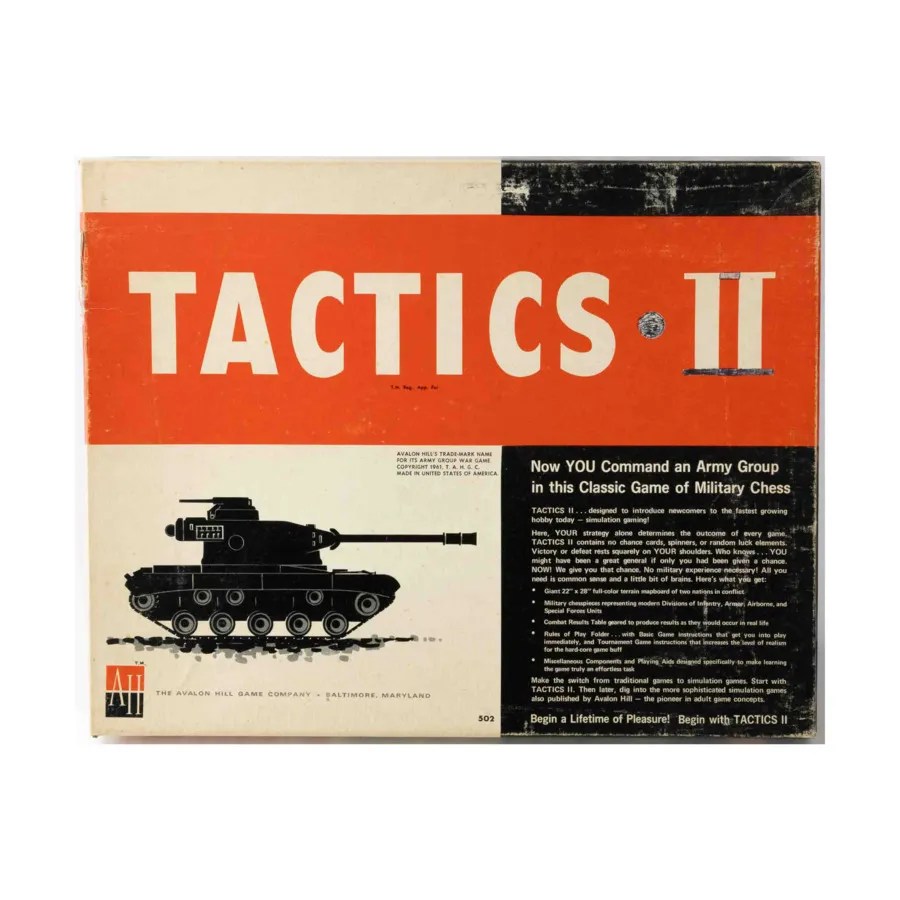
Avalon Hill’s Tactics and its second edition, Tactics II, are generally considered to be the first commercial tabletop wargames. If you’ve never heard of this kind of board game, don’t be surprised — even if you are a septuagenarian like me! Monopoly, and even Clue, were much, much bigger universal entertainments in that era. I played them as well when I was eleven. But Tactics II was such a phenomenal break with traditional board games, it immediately caught my attention that day when I saw its board and playing pieces displayed in an advertising case at the oh-so-respectable J.L. Hudson’s. I wanted it badly! That advertising display teased my nascent fascinations in both history and math (though the game involved neither). It depicted a military conflict between two fictitious powers, Red and Blue, each endowed with identical armies represented by cardboard playing pieces punched out from a card. Movement across the topographical map board was regulated not by a roll of dice (as in Monopoly) but over a grid based on rules for movement of different types of military units (armor moved faster than infantry, hence could traverse more squares on the grid during a game turn, especially if there was a road connecting them). Airborne units could literally be flown across the board and dropped deep inside enemy territory. A single die was employed, not for movement, but for combat results when opposing units met. A Combat Results Table yielded probabilistic outcomes for such engagements, based on combat values for different unit types, but again both armies had equal numbers of each. The map was an idealized depiction of terrain including mountains, open space with roads, cities, beaches (for amphibious assaults) and bridges across bodies of water. I had seen nothing like this before! Rules governed all movement and permissible combat, and victory was determined by … wait, I can’t remember now how you won! Was it destroying every piece of your opponent? Not likely – controlling certain geographic objectives would be better, but I still don’t recall! This memory blockage is key to my long-lasting fascination with the genre – it wasn’t about winning, but about learning those rules and considering the game not a test of virtue, strength, or intelligence, but an experiment in thinking and learning.
Tactics II was only the beginning of a hobby that, although interrupted in high school and college, came back to haunt me with a vengeance after graduate school, as I established myself in the profession of librarianship. I became enmeshed in a subscription to Strategy & Tactics magazine, from Simulation Publications, Inc. (SPI), beginning in the early 1970s. Each issue of Strategy & Tactics (“S&T”) contained a separate historical wargame, based loosely on the model of that original Tactics. Hence, each bimonthly issue gave me a new, easily digestible exercise for my historical (and data driven) interests. There was even a mechanism for subscribers to get together – based on geographic location! So, I soon accumulated a social group of wargamers near my new home in the DMV. It was a more rewarding social activity than barhopping looking for female casual partners. I became attached to those games in a critical period of my (single) young adulthood.
What did the design and explication, via historical articles in the magazine and the rules set, do to captivate me far more than did my childhood Tactics II? Arguably, it was the simulation aspect of the games. “What if?” scenarios, alternate history, were an integral part of the experience. Additionally, many games extended far beyond tactical situations on a battlefield map. Strategic analysis fell within the purview of SPI as well; the most complex, challenging simulation of all the game titles I ever acquired was War in the Pacific. This stupendous work of art covered the entire World War II Pacific Theater from 1941-45. I played it only once – stretching over at least two weeks with its twelve 22”x 28” map sheets covering my entire dining room table (with leaf extension) for the duration (no room left for meals!). I had found only one live opponent willing to engage in such an ambitious project – although, as I recall, additional “observers” may have attended.
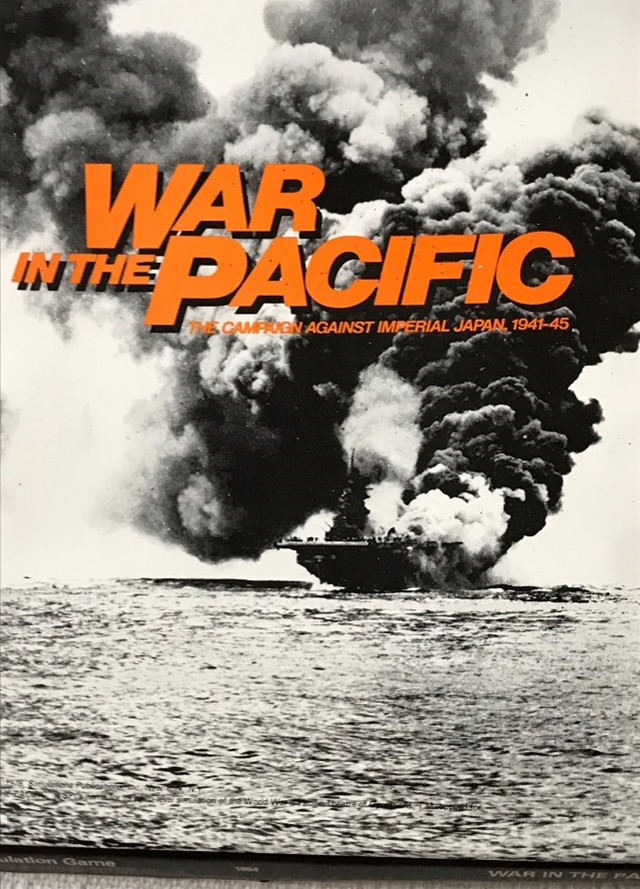
As with the more diminutive simulations, the real draw of War in the Pacific for me was NOT whether I could alter history, or whether I could win or lose the war, but the transcendent joy of learning. It was a knowledge machine. While the precept of reducing history to data and tables of combat results, with rules-based constraints on tactical and operational capabilities is highly questionable. But those features did focus players on decision-making as science more than art. The art in the games was the display, the maps, the cardboard counters, and the details of the rules set.
As the 1980s arrived, I became more interested in contemporary Cold War conflicts. History was less a motivator for me than strict military science – and modern hardware! Unfortunately, the social nature (meager though it was) of tabletop wargaming all but disappeared for me when I moved toward future combat scenarios. NOBODY was interested in this kind of simulation. Apparently, I was not involved enough with the foreign policy or defense establishment to know such people. Indeed, my closest friend and opponent in this period was somebody who WAS inside the intelligence community (CIA analyst) – and he steadfastly refused to participate in any hypothetical contemporary games, for fear of revealing classified knowledge he might possess. Nevertheless, my own interest in this field persisted (I had nothing to lose!). I began to design my own game based upon my copious reading in the area, as well as solitary play of some contemporary themed commercial games I acquired.
In 1983, I married — a marriage that has now lasted 41 years. My wife had no interest in my wargaming obsession! My final purchase of a tabletop wargame was “Gulf Strike,” from Avalon Hill subsidiary brand Victory Games, released that year. I still have this attractive boxed game, never played, cardboard counters never punched out. It was supposedly based on the Iran-Iraq War of the early ‘80s. But I never tested the hypothesis, despite following such contemporary conflicts in the media.
It was over. As I became a functional adult, life demanded more of me. I literally no longer had time to indulge in such a frivolous hobby. Yet I still read, I still write and think about the big questions in history and philosophy. If you follow Warp & Woof, you know this. But If I were to summarize why I left the tabletop wargaming hobby, and what I learned, I don’t believe I would blame those conflicting demands upon my time. I think there was something else — attributable to what the games taught me. I discovered the connection between military enterprises and the important struggles of civilization was bogus vaporware; armed conflict is NOT a feature, but a bug – there must be a way to fix it. Even if I’m wrong, after a quarter-century indulging myself in the hobby of tabletop wargaming, I could no longer countenance its underlying premise.
— William Sundwick
 Warp and Woof