Sometime in early adulthood (possibly after taking an undergraduate developmental psych course) I confronted my mother and father with an image that had just flashed into my consciousness. I attributed it to early childhood memory. It went something like this:
I remember exiting the kitchen screen door on a warm, sunny spring day – this must have been the house we lived in in Dearborn, Michigan until I was 6 years old because of its remembered layout – and I was dazzled by the sight of our new two-tone green 1950 Chevrolet Styleline Deluxe 2-door sedan! This is the full extent of the image that suddenly appeared in my mind – no extraordinary event to link to it, at least not that either me or my parents could recall. We bought a new car every year, so my dad could confirm that this was, indeed, an accurate memory of a car we had only when I was about 2 ½ – 3 ½ years old, and no longer! And my imprinted memory was clearly a warm, sunny day, hence apparently Spring or Summer of 1950 in Michigan.
Was it a real memory, or somehow implanted? (Obviously, my knowledge of the type and model of the car was inferred much later after I became a car connoisseur!). And if it was real, what possibly could have triggered it? Nobody had a clue. Recent research has confirmed that early childhood “explicit memories” (those related to some concept of “self,” autobiographical) may begin as early as 2 ½ years – not much earlier due to necessary linkage to language development. If it were implanted later, there would have to be some reason for the implantation. I had not participated in a psych experiment in my college course – and, even if I had, who would have known what car we had when I was 3 years old? It was a total nonevent, as far as any of us could determine.
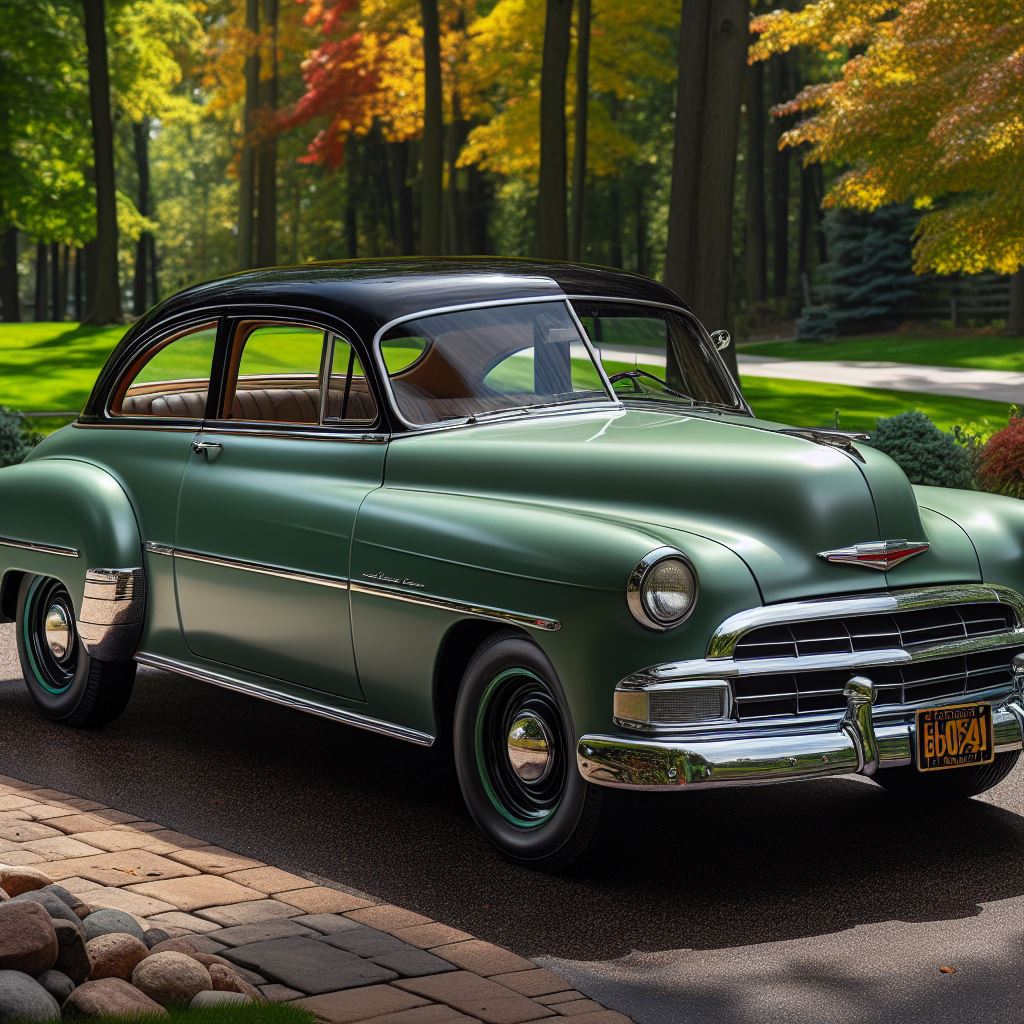
Recently, I asked Microsoft Copilot to conjure the image, “parked in a driveway in Dearborn, Michigan,” it generated this, with backdrop looking suspiciously like photos I’ve seen of Greenfield Village in Dearborn:
Not bad for generative AI. Some details of the car (I know as a devoted old car maven) aren’t quite right, but still pretty good. Copilot, using Dall-E, even got the two-tone paint scheme right – door posts were roof color, rather than lower body color, the later fashion. This downloaded photo of a 1950 Chevy Styleline Deluxe 2-door is better — I don’t recall from my mental image whether our rear fenders were skirted or not (a popular factory option back then, but inconsistent with my dad’s persona):
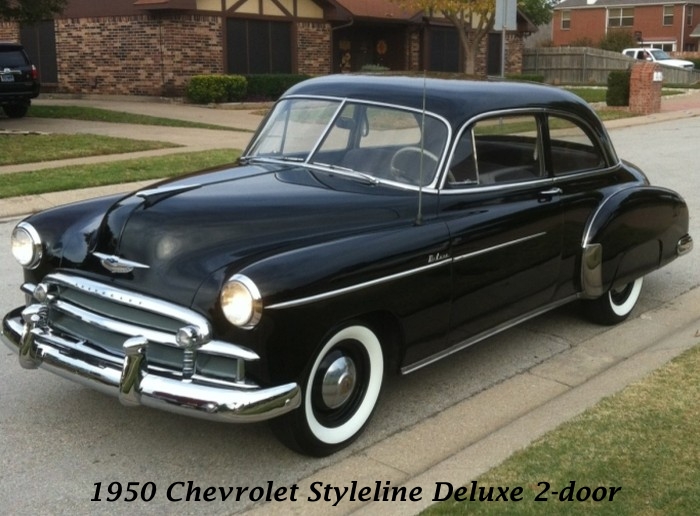
Whether pieced together from archived neurons somewhere in my brain, or suggested by some esoteric combination of subsequent knowledge (like that black car in the photo) interacting with real memory, the central issue in understanding such childhood memories seems to be: what do they mean?
If the earliest examples of these things are related to the development of some sense of self, combined with language to express that sense, then I need to ask what this specific memory tells me about my own soul.
Throughout my childhood we changed cars every year – a phenomenon common in those days among auto industry aspirants in Michigan. We always bought GM products (Dad’s employer). With my dad’s growing responsibility and status, Chevrolets ultimately gave way to Cadillacs. Later, when winding down his career as he approached retirement, we saw a devolution back to Chevrolets, Pontiacs, Oldsmobiles, and Buicks – and, post-retirement, no longer replaced every year. This one recalled car from 1950 was not unusual. It replaced a 1949 Chevy, and was replaced by a 1951 Chevy, which I remember only from photos in the now-lost family photo album. For some reason, this car remains a vivid image in my mind, sitting in our Dearborn driveway on that bright, sunny day.
Could it be that it was the sharing of the memory with my parents – both now long departed – that has continued to reinforce itself in my mind? I not only remember the image itself, but I distinctly remember running it by both parents as well. My mom wondered if there was some deep psychological impact for the event (or nonevent, as I characterized it) – what did she do? Did she lose track of me as I opened that screen door and wandered outside? Was this memory my earliest assertion of INDEPENDENCE? My dad found my relating of the episode, following that fancy intellectual prep he was paying so dearly for, to be amusing – entertaining! He eagerly tried to fill in as many details as possible about the car and the circumstances as he understood them. When I think of that exchange with both parents, as I was just entering adulthood myself, it now hits me as a transformative experience – not the actual memory but the relating of it to them. I was sharing with them something I had brought home! I can’t say I remember anything similar from my elementary school years; middle school and high school sharing experiences were primarily with peers, not parents. I may have seen this episode as a return on my father’s investment. He was now really interested in me, it seemed.
If it was all about relating the memory to my parents, that would count as a kind of self-implantation, or at least, self-reinforcement. But early childhood memories may have deeper implications. Over the last few decades, the impact of quantum physics has begun to seep into philosophy – thus, psychotherapy as well. Memory is now a question of consciousness, and consciousness is something which quantum mechanics impacts, questioning the nature of reality itself. In particle physics, we now know that quantum entanglement of particles over great distances (“spooky actions”) may not be limited to familiar objects but to wave interactions as well. And since science has not yet discovered what “consciousness” really is, we don’t know much about either dreams or early memories. When David Chalmers coined the term “the hard problem of consciousness” (1995) he was talking about the meaning of subjectivity, what is it like to be conscious? What is it like to have an experience? And, in the quantum universe, is there any reality that has not been measured? Recall the old, “if a tree falls in the forest, and nobody is there to see or hear it fall, does it really happen?” problem. Early childhood memories fit that mold nicely.
My memory of the car in the driveway, relating it to my parents, and then self-reinforcing the episode, may, in an ontological sense, be an example of Chalmers’ Hard Problem – quantum entanglement of inputs, experiences, thoughts, relationships – all of them together. The Problem remains unsolved.
— William Sundwick
 Warp and Woof