Social Change, a Mysterious Force
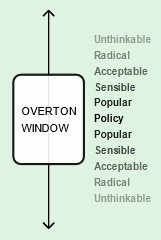
Joseph Overton, a Vice President of the libertarian think tank Mackinac Center, created a promotion for the Center’s programs in the 1990s. It was a brochure with a cardboard slider, which could move up and down over a spectrum of “more free” to “less free” political and social ideas. The possible range of public acceptance for these ideas went from “unthinkable” at both extremes, to “radical,” then “acceptable,” “sensible,” “popular,” before settling at “policy” in the dead center of the slider. Overton’s successors at the Mackinac Center decided to name the clever visual aid in his honor when he died in 2003: “The Overton Window.” Of course, the Center’s own ideological bias contributed to the nature of the scale on which various policy views were measured – the “more free” end of the scale meant less government influence or regulation, the “less free” side was intended to represent more government interference with citizens.
Over the last twenty years, the concept has caught on among many different strains of political commentators – especially during the Trump years. Indeed, its simple nature lends itself well to more traditional left/right analysis of ideas, which has been around since the French Revolution, despite the effort to avoid those labels by the Center. Thus, movement of the Overton Window is often seen as the level of public acceptance (and discourse) for any particular social or political policy. We can easily observe, within the span of our own memories, such movement in some ideas: integration of all ethnic or racial groups based on full equality; legal availability of cannabis; now the very nature of gender – as psychological preference rather than biological mandate. These things may be broader than Joseph Overton’s original premise. But people use the model as a valid measure of social change anyway.
By Hydrargyrum – Own work, based on discussion here and diagram here., CC BY-SA 2.0, https://commons.wikimedia.org/w/index.php?curid=37831314
For sure, social change is real – from one generation to the next, or one political regime to the next. And there are many of us who spend a great deal of time trying to figure out either how to bring about the changes we want faster, or how to prevent those changes — at least slow them down. This activity, after all, is what the Mackinac Center and many other ideologically based think tanks are all about.
But assigning a cause to any social policy is more difficult than identifying its effects. Let’s play a game. Think of various public policy positions and place them on an Overton Window of American public opinion in 2023 – then try to remember how we saw those positions in 2000. Can you see movement in the Window? Since 2000, we have experienced the end of one centrist Democratic administration, replaced by a conservative Republican one for eight years, then another eight years of a cautiously liberal, center-left, Democratic administration, followed by four years of a chaotic Republican administration flailing around in search of a paradigm, and now nearly three years into a confidently center-left (even social democratic) Democratic administration. Of course, the makeup of Congress has exerted considerable influence during all these years as well. But do politicians visualize movement in the Overton Window as synching with voter preferences? Do successful candidates during these years accurately reflect those changes?
Issue #1: Union Bargaining Power for Economic Growth – in 2023, public opinion in much of the American electorate seems to favor consumers and workers as engines of economic growth. In 2000, membership in traditional trade unions had been in decline for over two decades and would continue to decline for two more decades. Public opinion then was that entrepreneurs and corporations created economic growth, not consumers. Inflation had not been a problem since the 1970s, those risk-taking tech bros were the popular heroes. In 2023, a robust full employment economy and recent alarming upticks in inflation are seemingly related to a sharp rise in union organizing in sectors not represented twenty years ago. Blue-collar unions like the Teamsters and UAW are much more militant — strikes are back! Can the Overton Window now move in the direction of labor as the best bet for American workers – e.g., sectoral bargaining? Or is it just our current economic circumstances giving increased visibility to the labor movement? It could be both – the 2023 economic state causing more public acceptance of organized labor.
Issue #2: Same Sex Marriage – this one is frequently cited as the most obvious movement leftward (or toward the “more free” end) of the Overton Window. Clearly in the “radical” or “unthinkable” range in 2000, despite the quite visible existence of a Gay Rights Movement since at least 1969 (Stonewall Riots), Barack Obama refused to campaign in favor of gay marriage in 2008. Yet, without the need for a constitutional amendment, by 2015 the Supreme Court, followed rather abruptly by many public opinion polls, endorsed the right to marry whomever one chooses. Clearly, the Window moved, but what caused the move? Advocacy groups insist it was their coordinated campaign over four decades or so that finally bore fruit. But is there an alternative explanation? Perhaps, instead of the activists, it was simply a matter of the public growing more tolerant of all types of sexual nonconformity. Or it may have been the TV series “Will and Grace” – a subtle combination of both activism and public nonchalance.
Issue #3: Reproductive Freedom for Women – here, we have an apparent movement of the Overton Window from the 2000 status quo of what the Mackinac Center might call more freedom (of control over reproductive care) toward the “less free” world of 2023 regarding availability of legal abortion. But the post-Dobbs environment we live in now may not reflect movement of public opinion so much as politicians and political appointees (Supreme Court justices) acting in disregard of public opinion. This may represent the perverse side of the Overton Window: a steamroller effect generated by special interests (religious), well-orchestrated across society, but never having popular backing. It’s a case where we see the Window moving among the political class, but not the people.
So, how do we tell the difference between real public opinion versus the voices that political candidates hear? In the polarized world we inhabit, especially in 2023 (more than in 2000), tribal voices on any given policy issue may outshout the more scientific polling organizations’ efforts to reflect what people are really thinking. And, in the end, even those pollsters should probably be taken with a grain of salt by political campaigns. Nothing can supplant basic political instinct for being an advocate for your constituents – or potential constituents. Politicians of both parties need to be careful who gets their ear. They shouldn’t make assumptions about the Overton Window moving without first checking their evidence. But then, there is also that thorny matter of donors!
— William Sundwick
 Warp and Woof